
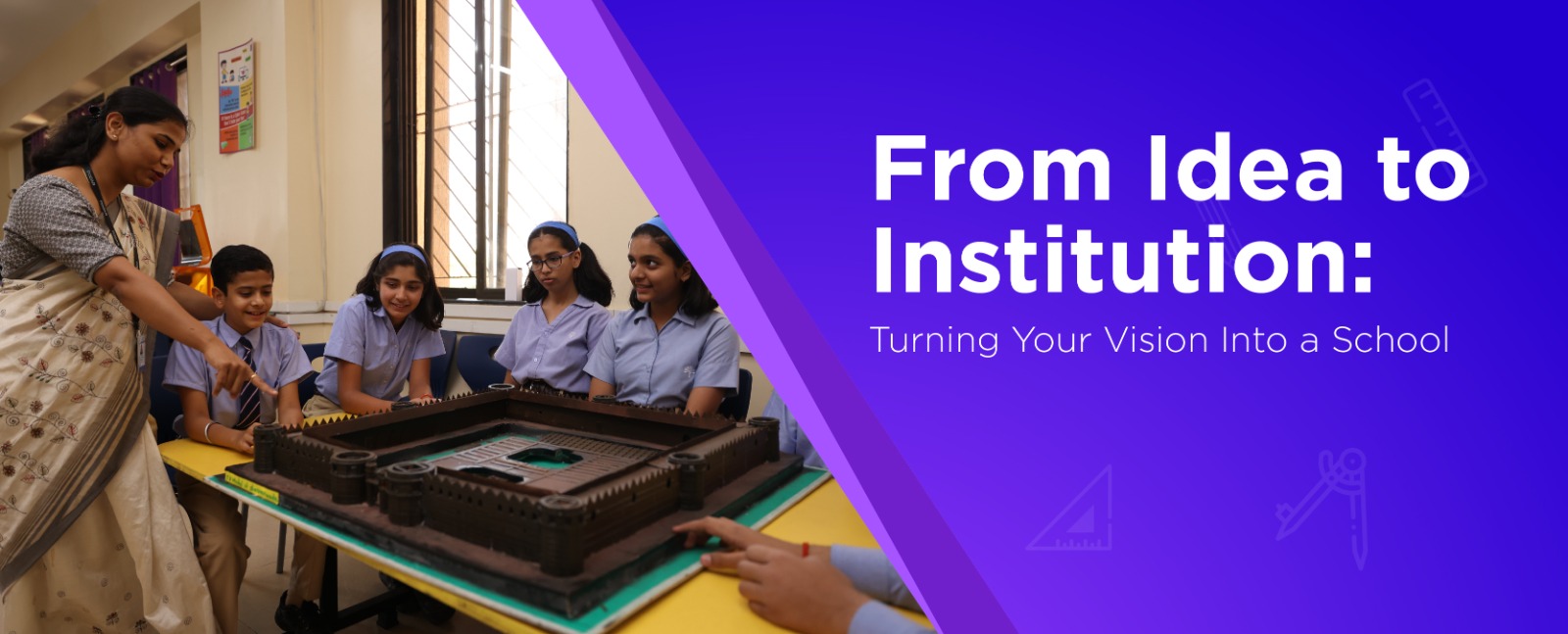
Every successful company begins with a simple idea – to make a difference. For many entrepreneurs and education-focused individuals, starting a school is an opportunity to create a lasting legacy and make a meaningful contribution to society. Although building a school can appear challenging, the right strategy, resources and support can make the journey considerably easier.
Enquiry Form
We request you to provide us your details in the below form and our representatives will get in touch with you at the earliest.
You can also contact us on the following numbers:
Maharashtra & Rest of India: 9930962227 Karnataka: 7506932440 / 7517690970 / 9324763534
Madhya Pradesh: 8976715408 Gujarat: 8425817555 / 8657950372
Step 1: Define Your Vision
The foundation of a successful school begins with a clearly defined vision and mission. Before moving into practical planning, a founder should understand what the school ultimately aims to achieve and the kind of educational environment it wants to create.
Important questions to consider include:
- What type of learning environment would I like to create?
- What values and principles will form the basis of the school?
- Who is the target audience and community?
A compelling vision gives the school a distinct identity. It also provides direction for important decisions and helps differentiate the institution in a competitive education market.
Step 2: Building a Foundation
Once the vision has been established, the next step is to create an actionable and structured plan for achieving it.
The foundation-building stage includes:
- Identifying the right location and physical infrastructure
- Designing the curriculum and establishing an academic framework
- Obtaining the necessary legal approvals and meeting regulatory requirements
- Recruiting qualified teachers and other school employees
Much of this stage involves behind-the-scenes planning. The objective is to ensure that the school is properly prepared to operate smoothly and meet the requirements of the education system.
A strong academic framework becomes easier to establish when founders have access to reliable curriculum support for schools covering lesson planning, learning outcomes and classroom delivery.
Step 3: Creating a Meaningful Learning Environment
A successful school should offer more than textbooks and conventional classroom instruction. The objective should be to support the holistic development of every student and encourage children to actively participate in their own learning.
The essential elements of such an environment include:
- Interactive and activity-based learning experiences
- Classrooms that are safe, inclusive and supportive
- Opportunities for creativity, sports and development of life skills
- Modern tools and technologies integrated into teaching approaches
When these elements work together, they help create a school community where students are encouraged to learn, participate and grow.
Step 4: Ensuring Sustainability and Growth
Building a school is an ongoing process rather than a one-time project. Long-term success requires the institution to continuously develop and adapt to changing requirements.
Future growth depends on factors such as:
- Maintaining a consistent approach to attracting students
- Maintaining strong academic standards and results
- Building trust within the local community
- Adapting to new developments and trends in education
A sustainable approach helps ensure that the institution remains relevant, active and capable of growing successfully over the long term.
Step 5: Leveraging the Franchise Advantage
For many entrepreneurs, working with an established education provider can make the journey from an initial concept to a functioning school significantly easier.
A franchise model can provide advantages such as:
- An established curriculum and proven teaching methods
- Credibility and recognition associated with an established brand
- Operational and training support
- Structured systems for setting up and managing the school
A structured school franchise model can reduce many of the risks and challenges associated with starting an education institution independently. It allows entrepreneurs to benefit from established systems and professional guidance while concentrating on building a quality educational institution.
Turning Your Vision Into Reality
Transforming the dream of creating a successful school into reality requires commitment, passion for education and the right support system. A school founder needs to be prepared for the challenges involved while maintaining a clear focus on the institution's long-term purpose.
Podar Smarter Schools combines a legacy of trust, academic innovation and comprehensive guidance to support start-up school founders. These elements can help entrepreneurs transform their vision into institutions that contribute to children's development and help build a better future.
By partnering with an established education organisation such as Podar Smarter Schools, entrepreneurs can benefit from a recognised name, innovative teaching methodologies and a structured support system while developing a business model that goes beyond pure profit.
Frequently Asked Questions
What is the first step to turn a school idea into an institution?
The first step is to define the school's vision, mission, values and target community. This provides direction for decisions related to learning methods, curriculum, location, infrastructure and long-term objectives.
Why is a clear school vision important before starting?
A clear school vision helps establish the identity of the institution and guides decisions concerning teaching methods, student experience, teacher recruitment, parent communication and future development.
What planning is needed before opening a school?
Founders need to plan the location, infrastructure, curriculum framework, legal approvals, teacher recruitment, safety systems and daily operations before opening the school. Proper preparation helps the institution operate smoothly from the beginning.
How can founders create a meaningful learning environment?
Founders can create a meaningful learning environment by incorporating activity-based learning, safe and inclusive classrooms, creativity, sports, life skills and modern teaching tools. These elements support both academic and overall student development.
Why is sustainability important when building a school?
Sustainability ensures that a school can continue to grow beyond its launch phase. Consistent admissions, academic quality, community trust, capable teachers and the ability to adapt to changing education trends are important for long-term success.
How does a school franchise model help new school founders?
A school franchise model can provide curriculum systems, teacher training, operational guidance, branding support, admissions assistance and structured processes. This can make establishing a new school easier than developing every system independently.
Who should consider starting a school franchise?
Entrepreneurs, landowners, education professionals and investors can consider a school franchise if they want to establish a long-term educational institution that combines business potential with meaningful social impact.
